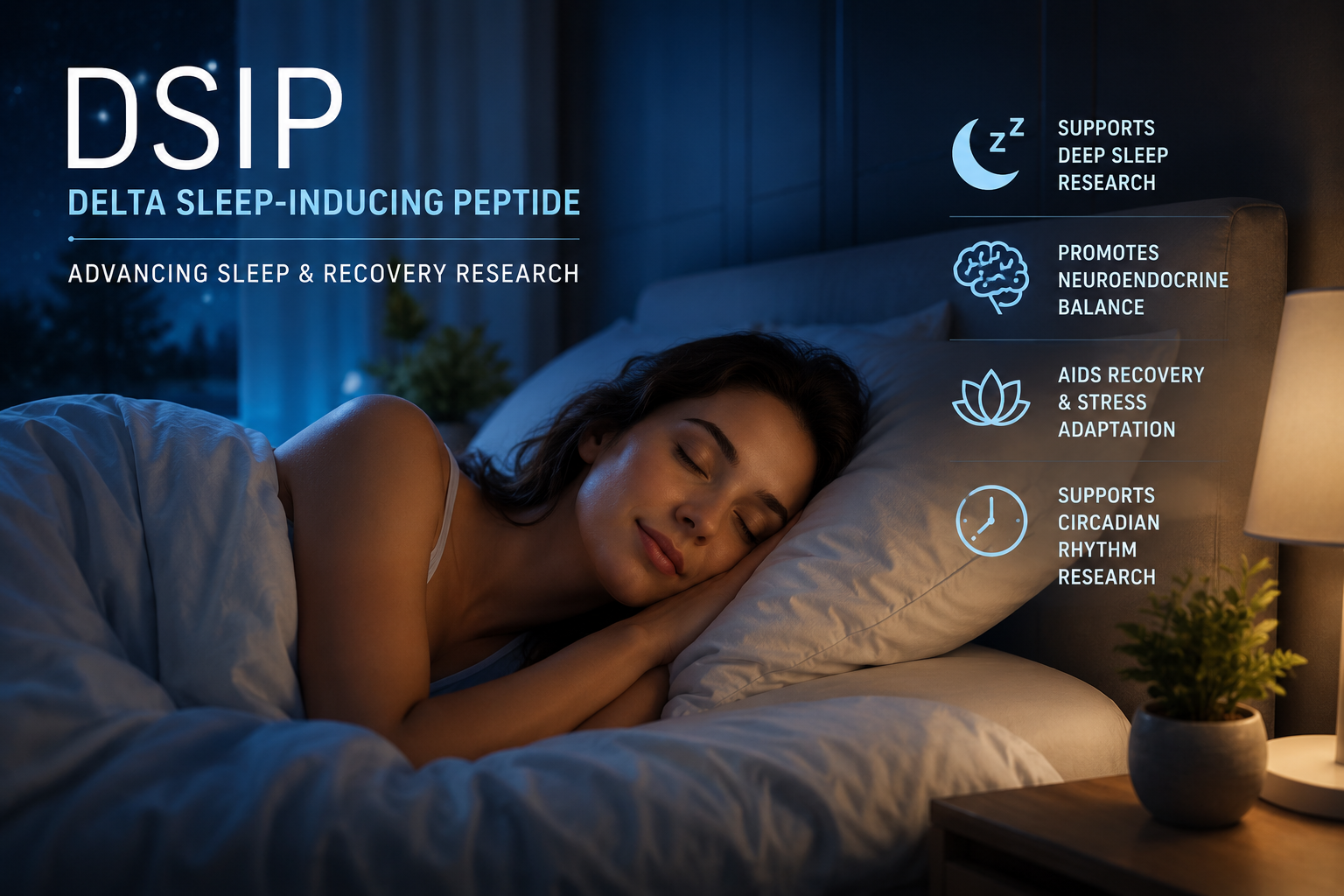
DSIP (Delta Sleep-Inducing Peptide): Research, Mechanism, and Potential Applications in Sleep and Recovery
What Is DSIP? Exploring the Science Behind Delta Sleep-Inducing Peptide
Sleep plays a critical role in physical recovery, cognitive function, hormone regulation, immune health, and overall well-being. As scientists continue exploring compounds involved in the body’s natural sleep processes, Delta Sleep-Inducing Peptide (DSIP) has remained an intriguing subject of research for decades.
Originally isolated in the 1970s, DSIP is a naturally occurring neuropeptide that has been investigated for its potential involvement in sleep regulation, stress response, endocrine function, and neurological activity. Although its exact physiological role continues to be studied, DSIP remains one of the most recognized research peptides in sleep science.
At Cryos Bio Labs, we supply premium laboratory-grade research peptides manufactured to high quality standards for scientific and laboratory research purposes only. This guide explores DSIP, its mechanism of action, current research, and why it continues to attract interest among researchers studying sleep biology and recovery.
What Is DSIP?
Delta Sleep-Inducing Peptide (DSIP) is a short peptide consisting of nine amino acids. It was first identified after researchers observed peptide activity associated with deep sleep patterns, particularly delta-wave sleep, the restorative stage of non-REM sleep.
Although originally believed to function primarily as a sleep-promoting peptide, subsequent research has suggested DSIP may participate in several physiological systems, including:
- Sleep regulation
- Circadian rhythm research
- Stress adaptation
- Neuroendocrine signaling
- Hormonal balance
- Nervous system function
Its broad biological activity has made DSIP a valuable research tool in neuroscience and peptide biology.
How Does DSIP Work?
The precise mechanism of DSIP remains under investigation.
Unlike many modern peptides that bind to a single well-defined receptor, DSIP appears to interact with multiple neurological and endocrine pathways. Researchers continue investigating how it influences communication between the brain and hormone-producing systems.
Current research suggests DSIP may influence:
- Sleep architecture
- Neurotransmitter balance
- Stress-response pathways
- Hormonal signaling
- Circadian rhythm regulation
- Central nervous system activity
Because these mechanisms remain incompletely understood, DSIP continues to be an active area of scientific investigation.
Why Researchers Study DSIP
DSIP has attracted interest because sleep influences nearly every major physiological system.
Researchers are investigating how DSIP may affect:
- Deep sleep physiology
- Recovery processes
- Hormonal regulation
- Cognitive performance
- Nervous system balance
- Stress resilience
Its naturally occurring structure also makes it valuable for studying endogenous peptide signaling.
Potential Research Applications
Sleep Research
The most widely recognized application of DSIP involves research into sleep quality and sleep architecture.
Investigators continue exploring whether DSIP influences:
- Delta-wave sleep
- Sleep efficiency
- Sleep onset
- Sleep maintenance
- Circadian rhythm regulation
Understanding these processes may provide insights into how naturally occurring peptides influence restorative sleep.
Stress Response Research
The body’s response to stress involves complex hormonal interactions.
DSIP has been investigated for its potential role in:
- Stress adaptation
- Cortisol regulation
- Neuroendocrine communication
- Recovery following stress exposure
Researchers continue examining these biological relationships.
Recovery and Regeneration
High-quality sleep supports:
- Muscle recovery
- Immune function
- Hormone production
- Tissue repair
- Cellular regeneration
Scientists are investigating whether DSIP-related pathways contribute to these natural restorative processes.
Neurological Research
DSIP has also been studied within neuroscience.
Research areas include:
- Brain signaling
- Neurotransmitter activity
- Cognitive performance
- Central nervous system regulation
- Neural recovery
These investigations aim to better understand peptide communication within the brain.
Endocrine Function
Some studies have examined whether DSIP interacts with hormone-producing systems.
Areas of ongoing investigation include:
- Growth hormone regulation
- Cortisol signaling
- Pituitary function
- Neuroendocrine communication
Further research is required to clarify these relationships.
Benefits Being Explored in Scientific Research
Researchers continue evaluating DSIP for its possible influence on:
- Sleep quality
- Deep sleep patterns
- Stress adaptation
- Recovery biology
- Hormonal balance
- Cognitive performance
- Nervous system regulation
- Circadian rhythm
- General physiological recovery
These areas remain under active investigation and should not be interpreted as established therapeutic effects.
DSIP and Sleep Science
Deep sleep is one of the most important phases of the sleep cycle.
During this stage the body performs numerous restorative functions, including:
- Tissue repair
- Immune regulation
- Memory consolidation
- Hormonal release
- Protein synthesis
Because DSIP was originally associated with delta-wave sleep, researchers continue exploring its role in these biological processes.
DSIP and Circadian Rhythm Research
Circadian rhythms regulate the body’s internal clock, influencing:
- Sleep timing
- Hormone secretion
- Body temperature
- Metabolism
- Cognitive alertness
Scientists continue studying whether DSIP participates in maintaining these natural biological rhythms.
DSIP Compared to Other Research Peptides
Unlike peptides such as Semaglutide, Tirzepatide, or Retatrutide that primarily target metabolic pathways, DSIP is investigated primarily for neurological and sleep-related research.
This makes DSIP unique among modern research peptides because its primary interest lies within neurobiology rather than metabolism.
Laboratory Research Considerations
DSIP is supplied exclusively for laboratory research purposes.
Proper laboratory handling includes:
- Following sterile research procedures
- Accurate measurement protocols
- Appropriate refrigerated storage
- Controlled laboratory environments
- Compliance with institutional research standards
Why Quality Matters
Reliable scientific research depends on consistent peptide quality.
Cryos Bio Labs is committed to supplying laboratory-grade research peptides with an emphasis on:
- High purity
- Batch consistency
- Secure packaging
- Reliable Canada-wide shipping
- Strict quality standards
- Responsive customer support
Researchers depend on consistent materials to achieve reproducible laboratory outcomes.
Frequently Asked Questions
What does DSIP stand for?
DSIP stands for Delta Sleep-Inducing Peptide, a naturally occurring neuropeptide investigated for its role in sleep biology and neuroendocrine function.
Is DSIP naturally occurring?
Yes. DSIP was originally identified as a naturally occurring peptide associated with physiological sleep processes.
What is DSIP researched for?
Scientists study DSIP in relation to:
- Sleep regulation
- Circadian rhythms
- Stress response
- Neurobiology
- Hormonal signaling
- Recovery physiology
Is DSIP approved as a medication?
DSIP remains an investigational peptide in many jurisdictions and is supplied by Cryos Bio Labs for laboratory research purposes only.
Why is DSIP popular among researchers?
Its unique relationship with sleep physiology and neuroendocrine signaling has made DSIP one of the most studied peptides in sleep-related scientific research.
Why Choose Cryos Bio Labs?
Cryos Bio Labs provides premium-quality research peptides for laboratories and scientific professionals throughout Canada.
Our commitment includes:
- Laboratory-grade peptides
- High purity standards
- Consistent manufacturing quality
- Secure packaging
- Fast Canada-wide delivery
- Educational resources
- Dependable customer service
Whether studying sleep physiology, peptide biology, neuroendocrine signaling, or recovery science, Cryos Bio Labs delivers products researchers can rely on.
Final Thoughts
Delta Sleep-Inducing Peptide remains one of the most fascinating investigational peptides in sleep and neuroscience research. While scientists continue to explore its exact biological functions, DSIP has maintained decades of research interest due to its potential relationship with deep sleep, circadian rhythms, stress adaptation, and neuroendocrine communication.
Although many questions remain, DSIP continues to serve as an important research tool for laboratories seeking to better understand the complex mechanisms that regulate restorative sleep and recovery.
For researchers seeking premium laboratory-grade peptides manufactured to rigorous quality standards, Cryos Bio Labs proudly supports scientific advancement with dependable research materials delivered across Canada.
DSIP Canada, Delta Sleep-Inducing Peptide, DSIP peptide, buy DSIP Canada, DSIP research peptide, laboratory-grade DSIP, sleep research peptide, peptide for sleep research, neuropeptide research, circadian rhythm peptide, recovery peptide research, stress response peptide, peptide biology Canada, high-purity DSIP, premium research peptides Canada, Cryos Bio Labs, sleep science peptide, neuroendocrine peptide, laboratory peptides Canada, research peptides Canada.